
The Annual Check-up: Why Your Practice Needs a Payment Processing Audit

Audit your processing rates → identify hidden fees → increase your practice’s bottom line without changing your clinical workflow.
In the medical world, we are obsessed with "outcomes." We track patient recovery speeds, success rates of new procedures, and the efficacy of various treatments. But there is one area of the practice that often suffers from chronic neglect: the financial plumbing.
Most medical practice managers and owners view credit card processing as a "set it and forget it" utility: much like the electricity or water bill. You signed a contract three years ago, the machines work, and the money hits the bank account. Why mess with it?
But here is the reality: "Set it and forget it" is a strategy that costs the average medical practice thousands of dollars in lost revenue every single year.
Payments technology and fee structures change faster than healthcare regulations. If you haven't looked at your merchant statement in over twelve months, you aren't just being "efficient": you’re likely leaking profit through a thousand tiny cuts.
🩺 The Symptoms of a "Stale" Processing Agreement
A medical practice is a unique business entity. Unlike a coffee shop with high-volume, low-ticket transactions, a medical office often deals with high-ticket elective procedures, insurance co-pays, and recurring patient payment plans.
Each of these transaction types carries a different level of risk and a different cost from the card brands (Visa, Mastercard, etc.). Over time, the gap between what you should be paying and what you are paying begins to widen.
This isn't necessarily because your processor is "bad." It’s because the industry moves on, and your old contract stays stagnant. According to a 2024 report on healthcare financial trends, audit risks for medical practices have increased by 61% year-over-year. While most people think of "audits" in terms of taxes or HIPAA, a financial audit of your overhead: specifically your merchant fees: is just as vital for the health of your business.
🔍 Conducting a Hidden Credit Card Fees Analysis
The first step in any check-up is a diagnostic test. In this case, that means a hidden credit card fees analysis.
Most merchant statements are designed to be intentionally confusing. They are filled with acronyms like "MTOT," "EGP," and "BSA." If you can’t read your statement, you can't tell if you're getting a fair deal.
What this is NOT: This isn't about looking for a cheaper "teaser rate."
What this IS: This is about identifying where your "Effective Rate" (the total amount you pay divided by the total amount you process) has crept up due to junk fees or "unbundled" costs.
📊 Typical Fee Breakdown (Visual)
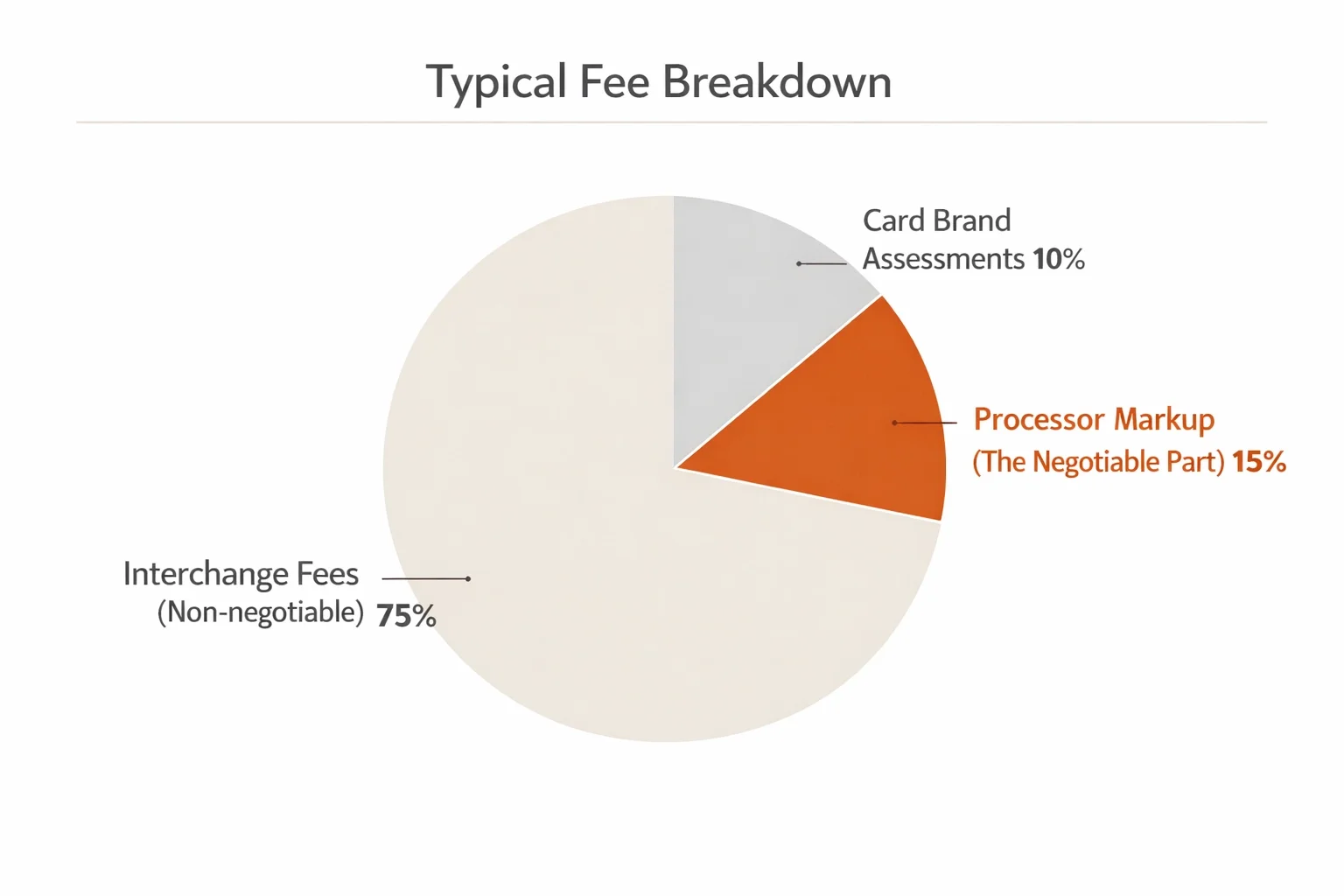
While the majority of fees are set by card brands, the 'Processor Markup' is where most medical practices are overcharged.
Look for these three red flags:
Tiered Pricing: If you see "Qualified," "Mid-Qualified," and "Non-Qualified" on your statement, you are likely overpaying. This is an opaque pricing model where the processor decides which transactions cost you more.
PCI Non-Compliance Fees: These are "penalty fees" that appear when your practice hasn't updated its security questionnaire. It is essentially free money for the processor and a sign of neglect on your end.
Statement Fees or "Service" Charges: These small $10 to $30 monthly additions add up. In a modern processing environment, many of these are unnecessary overhead.

📅 How Often Should You Review Your Rates?
In a perfect world, you’d glance at your statements monthly. But we know how busy a front desk gets. For most practices, a full annual audit is the "sweet spot" for maintaining financial health.
However, if your practice is experiencing any of the following, you should move that audit up to a quarterly schedule:
Rapid Growth: If your volume has increased by more than 20% in a year, you have more leverage to negotiate lower rates.
Adding New Services: Introducing high-ticket elective procedures changes your "average ticket," which can change your risk profile.
Software Changes: If you’ve implemented a new EHR or patient portal, how those systems "talk" to your processor can create new efficiencies: or new fees.
Regular reviews ensure you stay compliant with the Affordable Care Act (ACA) and CMS guidelines regarding financial transparency and patient billing. More importantly, it ensures your revenue cycle management stays optimized.
🔄 Stay Leveled Up Without Switching Processors
One of the biggest reasons medical admins avoid auditing their rates is the "switching headache." The thought of retraining the front desk, integrating new hardware, and changing the "Digital Front Door" is enough to make anyone stick with a bad deal.
But here is a secret the processing industry doesn't want you to know: You can often get better rates without switching your provider.
This is the "CHCU" (Clear Harbor Cinematic Universe) way of doing things. You can stay leveled up without switching processors by simply holding your current provider accountable to current market standards.
When you approach a processor with a professional hidden credit card fees analysis, you aren't asking for a favor: you are presenting data. You are showing them that you know the "Interchange" rates have changed and that you expect your "plus" (their margin) to reflect your practice's loyalty and volume.

💡 Why "Set it and Forget it" Is a Profit Killer
When you ignore your processing rates, you aren't just losing money; you’re losing the ability to reinvest in your practice.
Think of it this way: If an audit saves your practice just 0.5% on $2,000,000 of annual processing, that is an extra $10,000 in pure profit. That is a new piece of diagnostic equipment, a bonus for a hard-working nurse, or a significant boost to your marketing budget.
📊 Potential Annual Savings (Visual)
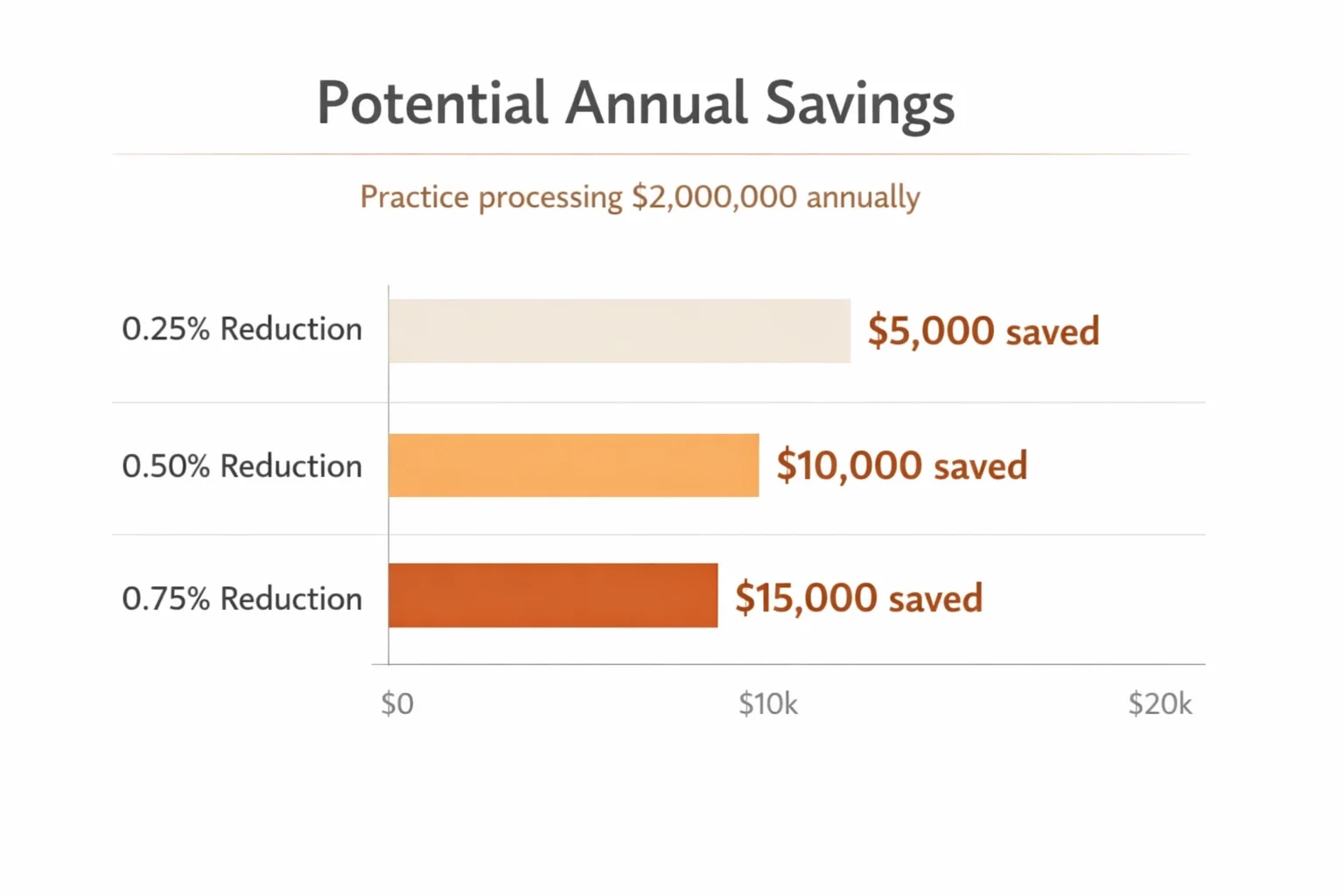
Even a fractional decrease in your effective rate can fund significant practice improvements.
Leaving that money on the table because "it’s too much work to look at the bill" is a silent revenue leak that can stunt your growth.
🛠️ Your 3-Step Audit Action Plan
Gather the Data: Pull your last three months of processing statements. Do not look at just one month, as seasonal volume (like end-of-year deductible spending) can skew the numbers.
Calculate Your Effective Rate: Divide your "Total Fees" by your "Total Volume." If this number is higher than 3% for a typical medical practice, you have significant room for improvement.
Request a Review: Contact your current provider and ask for an "Interchange Plus" pricing review. This moves you away from confusing "tiers" and into a transparent model where you pay the actual cost of the card plus a fixed, negotiated margin.

🤝 The Role of Merchant Advocacy
You don't have to do this alone. In the same way you might hire a specialized consultant to help with HIPAA compliance or medical coding, there are professionals who specialize in merchant advocacy.
A merchant advocate doesn't want you to switch your bank or your software. Their job is to sit on your side of the table and negotiate with the processor on your behalf. They use specialized software to find the "fat" in the statements and trim it away.
This approach is becoming the standard for high-growth practices because it removes the conflict of interest. If the advocate doesn't save you money, they haven't done their job. It’s a low-risk way to ensure your business margins remain healthy.

Final Thoughts: Don't Ignore the "Health" of Your Revenue
Your patients trust you to stay current on the latest medical advancements. Your practice deserves that same level of care when it comes to its financial operations.
And with operating costs reportedly rising 11.1% (MGMA 2025), every basis point you trim off overhead matters—because it protects staffing, equipment upgrades, and patient experience when budgets get tight.
By committing to an annual payment processing audit, you ensure that more of your hard-earned revenue stays within the practice walls. You protect yourself from fraud, you stay compliant with evolving regulations, and you ensure that your "Digital Front Door" is as efficient as possible.
Stop letting hidden fees be a "chronic condition" in your office. It's time for an annual check-up.
Want to learn more about protecting your practice's bottom line?
Check out our guide on plugging common revenue leaks.
Discover how merchant advocacy can help you save without switching.
Browse our Business Margins category for more tips on operational efficiency.
Educational • No-pressure • Obligation-free